

The art of brewing pour-over coffee has become very popular around the world. More and more people are trying to get better at making it. As someone who loves great coffee, I’m happy to share my knowledge with you.
In this detailed guide, I’ll show you how to make the perfect cup of coffee. We’ll cover everything from choosing the right gear to mastering the brewing technique. Whether you’re new to coffee or already know a lot, you’ll find useful pour over coffee tips here.
Key Takeaways
- Learn the basics of pour-over coffee brewing
- Discover the essential equipment needed
- Master the technique for a perfect cup
- Explore tips for customizing your brew
- Enhance your coffee experience with expert advice
What is Pour Over Coffee?
Pour over coffee is a favorite among coffee lovers. It has a long history, even though it’s more popular now than ever. This method lets you make a very tasty cup of coffee by controlling how it’s brewed.
Definition and Overview
Pour over coffee is made by pouring hot water over coffee grounds in a filter. It’s loved for its ability to control brewing details like water temperature and coffee-to-water ratio. You’ll need a pour over dripper, a filter, and a coffee grinder to make it.
This method brings out the coffee’s complex flavors, making a clean and nuanced cup. It takes some practice, but it’s worth it.
Brief History of Pour Over Coffee
The pour over method started in the early 20th century. It was influenced by the German Melitta company, which made the first pour-over coffee makers. Over time, designs like the Hario V60 and the Chemex were introduced. For more on pour over coffee, check out Counter Culture Coffee’s guide.
Today, pour over coffee is enjoyed globally. It’s loved for its simplicity and the control it gives over brewing. The best pour over coffee method combines the right gear, quality beans, and practice to perfect the brew.
- Key elements of pour over coffee include:
- Manual brewing process
- High degree of control over brewing parameters
- Use of a filter to separate coffee grounds from the liquid
- Emphasis on extracting complex flavors from the coffee beans
Essential Equipment for Pour Over Brewing
To make the perfect pour over coffee, you need the right tools. Pour over brewing is a detailed process. It requires a few key items to make a great cup.
Coffee Maker Options
There are many pour over coffee makers to choose from. Brands like Hario and Chemex stand out. They offer features that suit different tastes.
- Hario V60: It’s known for its glass design and bringing out coffee’s flavors.
- Chemex: It’s famous for its hourglass shape and thick glass. This makes for a clean and balanced coffee.
Other brands like Kalita and Bonmac also offer great options. They have different materials and designs to improve your brewing.
Filters and Their Importance
Filters are key in pour over brewing. They affect the taste and quality of your coffee. Paper filters are the most used, but metal and cloth filters also have their benefits.
- Paper filters: They absorb some oils, making the coffee taste cleaner.
- Metal filters: These let more oils through, making the coffee richer.
- Cloth filters: They offer a balanced taste, between paper and metal in oil passage.
Coffee Grinder Recommendations
A good coffee grinder is vital for the right grind size. This is key for pour over brewing. I suggest using a blade grinder or a burr grinder for better results.
Burr grinders are best for a uniform grind. This is important for balanced extraction. Some top burr grinders include:
- Baratza Encore: It’s known for its consistency and ease of use.
- Breville Smart Grinder: It offers precision and a wide range of grind settings.
Choosing the Right Coffee Beans
The journey to a perfect pour over starts with picking high-quality coffee beans. There are many options, so knowing what each type offers is key. This knowledge makes brewing a delightful experience.
Types of Coffee Beans
Coffee beans come in types like Arabica and Robusta. Arabica is loved for its complex flavors and aromas. Robusta, on the other hand, has a bolder taste and is used in instant coffee.
- Arabica: Known for its mild, nuanced flavor profiles.
- Robusta: Offers a bold, bitter taste, often used in espresso blends.
- Liberica: A rare species with a unique flavor profile, often described as fruity.
- Excelsa: A hybrid of Liberica and Arabica, with a balanced taste.
Roast Levels and Their Flavor Profiles
The roast level of your coffee beans greatly affects the taste of your pour over. Lighter roasts keep the coffee’s natural acidity and flavors. Darker roasts give a richer, more bitter taste.
| Roast Level | Flavor Profile |
|---|---|
| Light Roast | Fruity, floral, with high acidity |
| Medium Roast | Balanced acidity and body, with nuanced flavors |
| Dark Roast | Rich, bold, with reduced acidity and deeper flavors |
Freshness and Grind Size
Freshness is key for coffee beans. Choose beans roasted recently and store them well to keep flavors. The grind size is also important for pour over brewing. A medium to fine grind is best.
Grind your coffee beans just before brewing for the best flavor. Grinding too early can lose the delicate flavors and aromas.
In conclusion, picking the right coffee beans means considering type, roast, freshness, and grind size. Understanding these factors can greatly improve your pour over coffee, making it just right for you.
The Importance of Water Quality
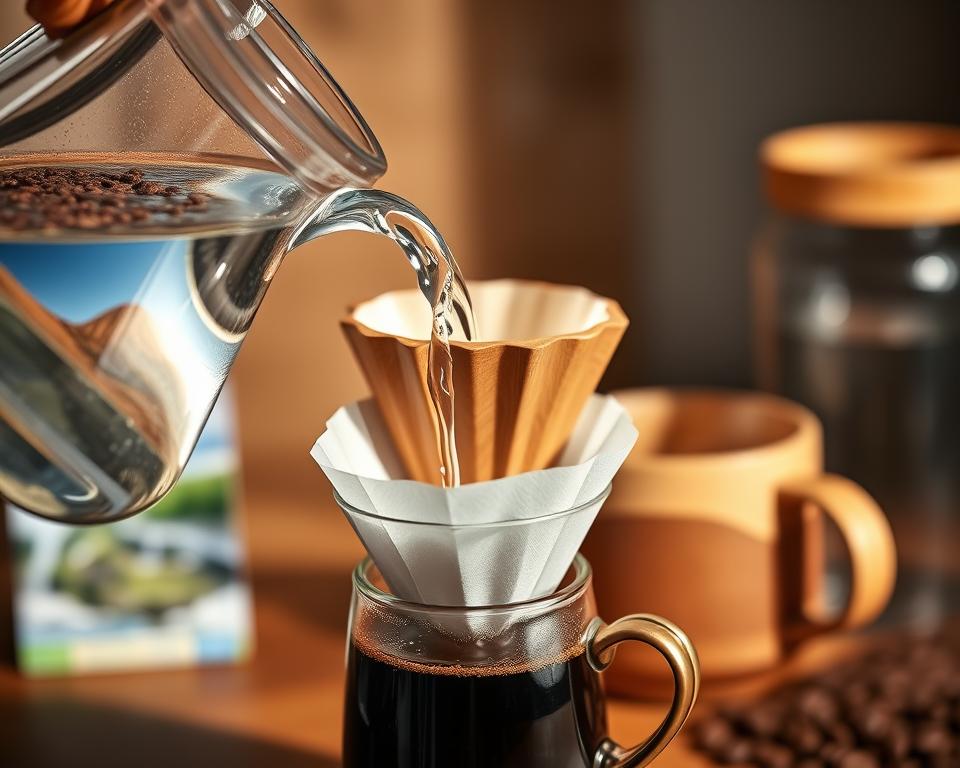
Brewing great pour-over coffee starts with understanding water quality. Water makes up about 98% of your coffee. The quality of the water greatly affects the taste of your coffee.
Water Temperature
The ideal water temperature for brewing coffee is between 195°F and 205°F. Water that’s too hot can burn the coffee. Water that’s too cold can make the coffee taste weak.
To get the perfect temperature, use a thermometer or an electric kettle with temperature control.
Filtered vs. Tap Water
There’s a debate about using filtered water or tap water for coffee. Tap water can have impurities that change the taste of your coffee. Filtered water can remove these impurities, making the taste cleaner.
But, over-filtering can also remove good minerals. To find a balance, use a water filter that removes impurities without taking away minerals. Some coffee lovers even use a special water filter for brewing.
The Role of Mineral Content
Mineral content in water is key to the flavor of your coffee. Minerals like calcium and magnesium help extract coffee’s good compounds. But, too many minerals can make the coffee taste bitter.
Knowing the mineral content of your water helps you adjust your brewing. For example, if your water is very hard, you might need to change the grind size or brewing time.
Mastering the Pour Over Technique
Learning the pour over technique takes patience, practice, and a good understanding of brewing. It’s key to know that the technique is as important as the equipment and coffee beans.
The Bloom Phase
The bloom phase is a vital step in pour over brewing. It’s when hot water is poured over the coffee to release CO2. This allows for even extraction. Allowing the coffee to bloom improves flavor by letting water penetrate the grounds better.
“The bloom phase is critical for balanced extraction,” coffee lovers say. “It prepares the ground for the rest of the brewing process.”
Pouring Methods
The way you pour water over coffee grounds affects the taste. A steady, circular motion is best for even saturation. The pouring method can change the extraction rate and flavor.
- Start with a gentle pour to wet the grounds.
- Then, pour in a steady, circular motion.
- Change your pouring speed to control extraction rate.
Timing Your Brew
Timing is key in pour over coffee. The brew time affects flavor, usually between 3 to 4 minutes. Monitoring your brew time and adjusting grind or pouring can perfect your cup.
A brew time of 3:30 minutes is often ideal. But, it can vary with personal taste and coffee beans.
Common Mistakes to Avoid
To make great pour-over coffee, it’s key to know the mistakes that can ruin your cup. Even coffee lovers can make mistakes, but knowing them helps you improve. This way, you can make better coffee.
Over-extraction vs. Under-extraction
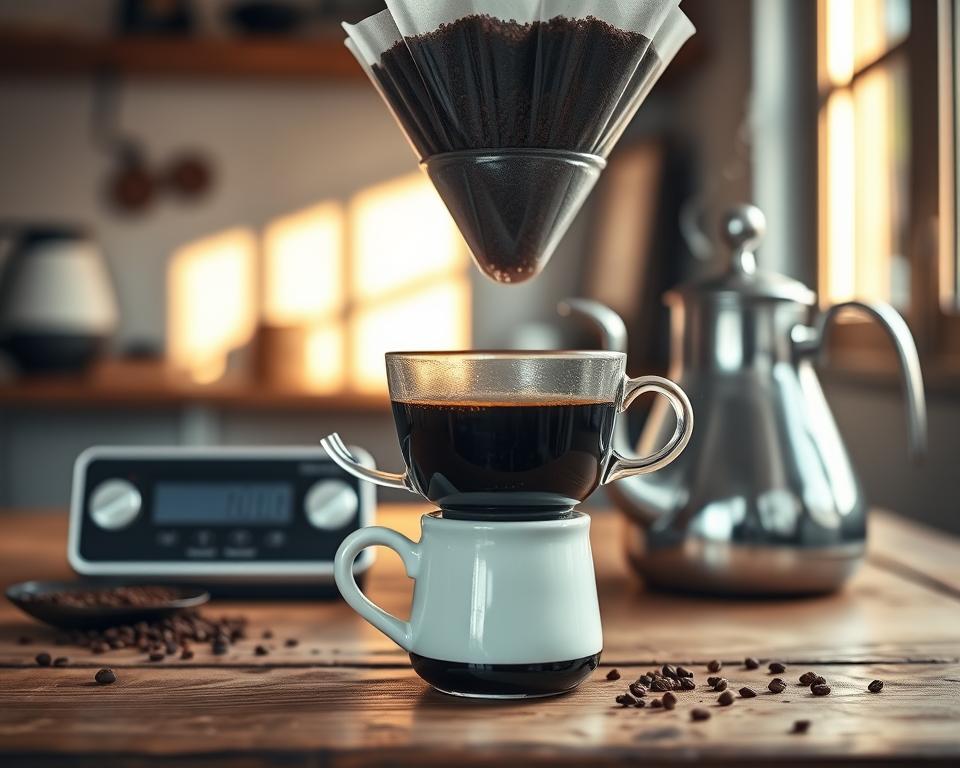
Getting the right balance is key in pour-over brewing. Over-extraction makes coffee taste bitter. Under-extraction makes it sour or weak.
James Hoffmann, a coffee expert, said, “A great cup of coffee is when extraction is just right.” To fix this, watch your brewing time and adjust the grind size.
Wrong Water Temperature
Water temperature is very important in pour-over brewing. Water that’s too hot burns the coffee. Water that’s too cold doesn’t extract enough.
The best temperature for brewing coffee is between 195°F and 205°F. Using a thermometer helps get this perfect temperature. Tristram Stuart, a coffee expert, says, “The right water temperature is key for extracting the best coffee solids.”
Inconsistent Grind Size
Uneven grind size causes channeling, where water flows unevenly. This makes the flavor unbalanced. To avoid this, use a high-quality grinder for a consistent grind.
“A good grinder is an essential tool for any coffee brewer. It allows you to adjust the grind size to suit your brewing method and ensures a consistent flavor.”
By knowing these common mistakes and avoiding them, you can greatly improve your pour-over brewing. This way, you’ll enjoy a perfect cup every time.
Flavor Profiles and Tasting Notes
Pour-over coffee gives you a rich taste experience. The flavors can change a lot. This is because of the coffee beans, roast level, and how you brew it.
Identifying Flavor Notes
Exploring the flavors in your pour-over coffee is fun. First, notice the coffee’s acidity, body, and finish. Acidity is the sharp, lively tastes. Body is how it feels in your mouth. The finish is what you taste after swallowing.
Common tastes include fruity, floral, and chocolatey. Ethiopian beans often taste fruity and floral. Brazilian beans might taste nuttier. Trying different beans and roasts can help you find your favorite taste.
Adjusting Brew for Your Preference
Changing how you brew your pour-over can change the taste. The grind size of your beans matters a lot. A finer grind makes the coffee stronger and more intense. A coarser grind makes it smoother and more balanced.
The water temperature is also key. Water that’s too hot can make the coffee bitter. Water that’s too cold can make it weak. The best temperature for pour-over coffee is between 195°F and 205°F.
| Flavor Profile | Recommended Adjustment |
|---|---|
| Fruity/Floral | Use a lighter roast and a finer grind. |
| Nutty/Chocolatey | Opt for a darker roast and a slightly coarser grind. |
| Balanced/Smooth | Adjust your water temperature to between 195°F and 205°F. |
By tweaking these factors, you can make your pour-over coffee just right for you. Whether you like a bright, acidic coffee or a smooth, chocolatey one, trying different beans and techniques can help you get your perfect cup.
Troubleshooting Your Brew
Brewing pour over coffee can be tricky, even with great technique. It’s key to know how to solve common problems to get the perfect cup. This is true for both new and experienced coffee lovers.
Fixing Common Problems
One big issue is channeling, where water flows too fast through the coffee grounds. This makes the coffee under-extracted. To fix it, make sure the coffee grounds are spread out evenly. Pour the water in a circle to soak all grounds well.
Another problem is when coffee tastes too bitter or sour. This can happen if it’s over- or under-extracted. Changing the grind size and brewing time can solve this. For example, if it’s too bitter, try a coarser grind or less brewing time.
- Check your grind size: Make sure it’s right for pour over coffee.
- Adjust your water temperature: Aim for 195°F to 205°F.
- Monitor your brewing time: Aim for 3-4 minutes total.
- Use the right water ratio: Find the perfect balance for your taste.
Adjusting for Altitude
Brewing coffee at high altitudes is tough because of lower air pressure and humidity. The water boils at a lower temperature, which can make the coffee taste different. This might make it under-extracted.
To adjust for altitude, try these:
- Adjust your grind size: A finer grind can help with the lower water temperature.
- Use hotter water: Try to get water closer to the ideal temperature.
- Experiment with brewing times: You might need to change your brewing time for the best extraction.
By tackling these common issues, you can improve your pour over brewing. This way, you can enjoy great coffee, no matter where you are.
Exploring Different Pour Over Methods
The art of pour over brewing offers many methods, each with its own charm. Coffee lovers can dive into these techniques to better understand pour over coffee. This exploration helps us find the perfect method for our taste.
Chemex vs. Hario V60
The Chemex and Hario V60 are two top pour over methods. The Chemex brews a clean, balanced coffee with its thick glass and paper filters. The Hario V60, with its cone shape and varied filter options, brings out more complex flavors.
Choosing between these methods depends on your coffee taste. If you prefer a milder coffee, the Chemex is great. For a richer flavor, try the Hario V60. Learn more about pour over brewing on Whole Latte Love’s guide.
AeroPress Pour Over Technique
The AeroPress is a versatile tool for pour over coffee. The AeroPress pour over technique involves steeping coffee grounds in hot water. Then, pressing the mixture through a filter creates a smooth, full-bodied coffee.
Using an AeroPress is quick and allows for precise control over brewing. It’s perfect for experimenting with roast levels and brewing times to perfect your coffee.
In conclusion, trying out different pour over methods can greatly improve your coffee experience. Whether you use a Chemex, Hario V60, or AeroPress, knowing each method’s strengths will help you find the best pour over coffee method for you.
Storing Your Coffee Properly
Keeping your pour-over coffee fresh is key. Whether you store whole beans or ground coffee, the right method makes a big difference. It affects how your coffee tastes.
Best Practices for Keeping Coffee Fresh
For the longest freshness, store coffee in a cool, dark spot. Light and heat can quickly spoil it, making it taste and smell less good. Use an airtight container to block air, moisture, and light.
Here are some tips:
- Store coffee in an airtight container to preserve freshness.
- Keep the container away from direct sunlight and heat sources.
- Avoid storing coffee near strong-smelling foods, as coffee can absorb odors easily.
- If you’ve bought whole beans, grind them just before brewing to ensure optimal flavor.
Choosing the Right Storage Containers
The container you choose affects your coffee’s freshness. Use containers that are non-reactive and airtight. Glass or ceramic with tight lids are great for coffee.
| Container Material | Pros | Cons |
|---|---|---|
| Glass | Non-reactive, easy to clean | Can be heavy, prone to breakage |
| Ceramic | Non-reactive, aesthetically pleasing | Can be expensive, may have lead-based glazes |
| Stainless Steel | Airtight, durable | Can impart metallic flavors, not transparent |
Think about size, material, and seal when picking a container. A big container lets in too much air. An open container lets in moisture and light, spoiling your coffee.
By following these tips and picking the right container, you can enjoy your pour-over coffee at its best. Even days after it’s been roasted or ground.
Pour Over Coffee Recipes to Try
Now that you know the basics of pour over coffee, it’s time to try new recipes. Trying different pour over coffee recipes can make your coffee better. You’ll discover new tastes.
Classic Pour Over Recipes
Begin with a simple yet tasty classic pour over recipe. Use a medium-roast coffee from a well-known roaster like Blue Bottle Coffee or Intelligentsia Coffee. Adjust the coffee-to-water ratio to your liking. Enjoy the rich flavors of your pour over brew.
Exploring Flavored Variations
For a twist, try adding different flavors to your pour over coffee. You can add a hint of vanilla or hazelnut with flavored syrups from Monin or Torani. Try changing the grind size or brewing time to enhance the flavor.
Whether you prefer a classic pour over or a flavored one, the secret to great pour over coffee is quality ingredients and careful brewing. With practice and patience, you can make pour over coffee as good as your favorite coffee shop’s.