


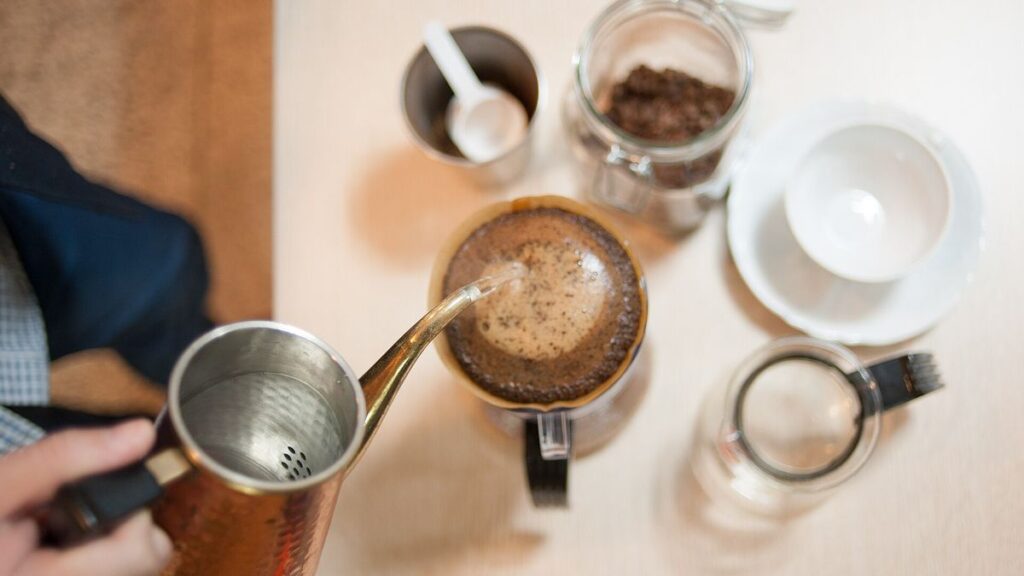
You bought good beans, you have a dripper and a kettle, and yet the cup tastes thin, sharp or harsh. That does not mean the coffee is bad or that you need new gear. It usually means the recipe is not yet matched to that particular bag. Baristas call the process of fixing this “dialing in,” and it is something you can do at home with a few simple habits.
In this guide you will learn how to taste a cup and name what is wrong, which variable to change first, how to make small adjustments without getting lost, and how to keep notes so the next bag takes fewer attempts. The method works for most cone and flat-bottom drippers, from a V60 to a Kalita Wave.
Start with a stable baseline recipe
Dialing in only works if you change one thing at a time, so you need a fixed starting point. Pick a simple recipe and write it down before you brew:
- Dose and ratio. Many home brewers start around 1 gram of coffee for every 15 to 17 grams of water. For one mug, something like 15 g of coffee to 250 g of water is a comfortable place to begin.
- Grind size. Medium-fine, roughly the texture of coarse table salt. Your grinder’s exact setting matters less than staying consistent.
- Water temperature. Just off the boil for light and medium roasts. For darker roasts, letting the kettle rest a little longer often softens bitterness.
- Bloom. Pour about twice the weight of the coffee in water, wait 30 to 45 seconds, then continue.
- Total brew time. For a single cup in a cone dripper, many recipes finish somewhere around two and a half to three and a half minutes.
Use a scale and a timer. Guessing by eye makes it almost impossible to know what changed between one cup and the next, and that is the whole point of the exercise.
Learn to name what is wrong
Before touching any setting, taste the cup as it cools a little. Coffee that is too hot hides flaws, and slightly cooler coffee shows them clearly. Then try to place it in one of these groups:
- Sour, sharp, thin, salty or “empty” finish. This is the classic sign of under-extraction: the water did not pull enough of the sugars and heavier compounds out of the grounds.
- Bitter, dry, astringent, hollow in the middle, leaves your mouth feeling chalky. This usually points to over-extraction: the water kept pulling after the pleasant flavors were already in the cup.
- Weak and watery but not especially sour or bitter. The cup is probably under-concentrated. The extraction may be fine, but there is simply too much water for the amount of coffee.
- Heavy, muddy, overwhelming, hard to drink. The opposite: too concentrated, often from too much coffee for the water used.
It helps to separate two ideas. Extraction is about how much flavor came out of the grounds. Strength is about how much of that flavor ended up in each sip. A cup can be well extracted and still too weak, or strong and still sour. Naming the problem correctly tells you which knob to turn.
Adjust grind size first
Grind size is the most powerful variable in pour-over because it changes both how fast water flows through the bed and how much surface area the water touches. It is almost always the first thing to adjust.
- If the cup is sour or thin: grind a little finer. Finer grounds slow the flow and expose more surface, so more flavor comes out.
- If the cup is bitter or dry: grind a little coarser. Water moves through faster and extracts less.
Make small moves, one or two steps on most home grinders, and brew again with everything else unchanged. A big jump often swings you from sour straight to bitter and makes it hard to find the sweet spot in between.
Watch the drawdown time
The drawdown is the moment from your last pour until the water finishes draining from the bed. Note the total brew time every cup. If you grind finer and the brew suddenly takes much longer than before, or the bed stalls and drips slowly at the end, you may be producing too many fine particles. In that case try a step back and look at your pouring instead.
Fix strength with the ratio, not the grind
If the flavor is balanced but the cup feels watery, resist the urge to grind finer. Instead, change the ratio:
- Too weak: use a little more coffee for the same water, for example moving from 15 g to 16 g for 250 g of water.
- Too strong: use a little less coffee, or add a splash of hot water to the finished cup to test whether a lighter ratio would suit you.
Adding water after brewing is a quick experiment many baristas use. If the cup tastes better diluted, you know the next brew should use a slightly longer ratio. Keep the grind where it is when you make this change so you are only testing one variable.
Fine-tune with pouring and water
Once grind and ratio are close, smaller details can lift the cup from good to great.
- Pour pattern. Pouring in slow, steady spirals keeps the bed even. Pouring hard into one spot can dig a channel where water rushes through and under-extracts, while the rest of the bed over-extracts.
- Number of pours. Splitting the water into several smaller pours tends to increase extraction slightly; a few larger pours can make the cup a little lighter. Try both and see which you prefer for a given coffee.
- Gentle agitation. A soft swirl of the dripper after the last pour helps flatten the bed so water drains evenly. Avoid aggressive stirring until you know how it affects your coffee.
- Water quality. Very hard water can make coffee taste flat and chalky, and very soft or distilled water can make it taste sharp and thin. If you have tried everything else, brewing with a filtered or bottled water can be a revealing test.
- Paper rinse. Always rinse the paper filter with hot water before adding coffee. It removes papery taste and preheats the dripper.
Keep a simple brew log
The fastest way to get better at dialing in is to stop relying on memory. A notebook or a note on your phone is enough. For each cup, record:
- Coffee name, roast date and roast level.
- Dose, water weight and grind setting.
- Water temperature and number of pours.
- Total brew time.
- One or two words about the taste: sour, sweet, bitter, flat, juicy.
Here is how a typical session might look with a washed Ethiopian light roast. The first cup at the starting recipe tastes bright but sharp and thin, and finishes in about two and a half minutes. Grinding two steps finer makes the second cup sweeter, but still a little light, finishing closer to three minutes. Moving the dose from 15 g to 16 g keeps that sweetness and adds body. Three cups, three single changes, and you have a recipe you can repeat every morning until the bag runs out.
Remember that coffee changes as it ages. Beans that are very fresh can bubble a lot and brew unevenly, and beans that are a few weeks older may need a slightly finer grind to taste as sweet. A short log makes these small corrections easy.
Summary
Dialing in pour-over is a matter of tasting carefully and changing one thing at a time. Start from a written baseline recipe, measured with a scale and a timer. Decide whether the cup is under-extracted (sour, thin), over-extracted (bitter, dry), too weak or too strong. Fix extraction with grind size and strength with the coffee-to-water ratio. Then refine with pouring technique, gentle agitation and better water. Keep a short brew log, and each new bag of coffee will take only a few cups to taste its best.
Photo: Manual drip (pour-over) coffee, by Kim Sanso, license CC0, via Wikimedia Commons. Cropped.